JEFF
MCCALLUM
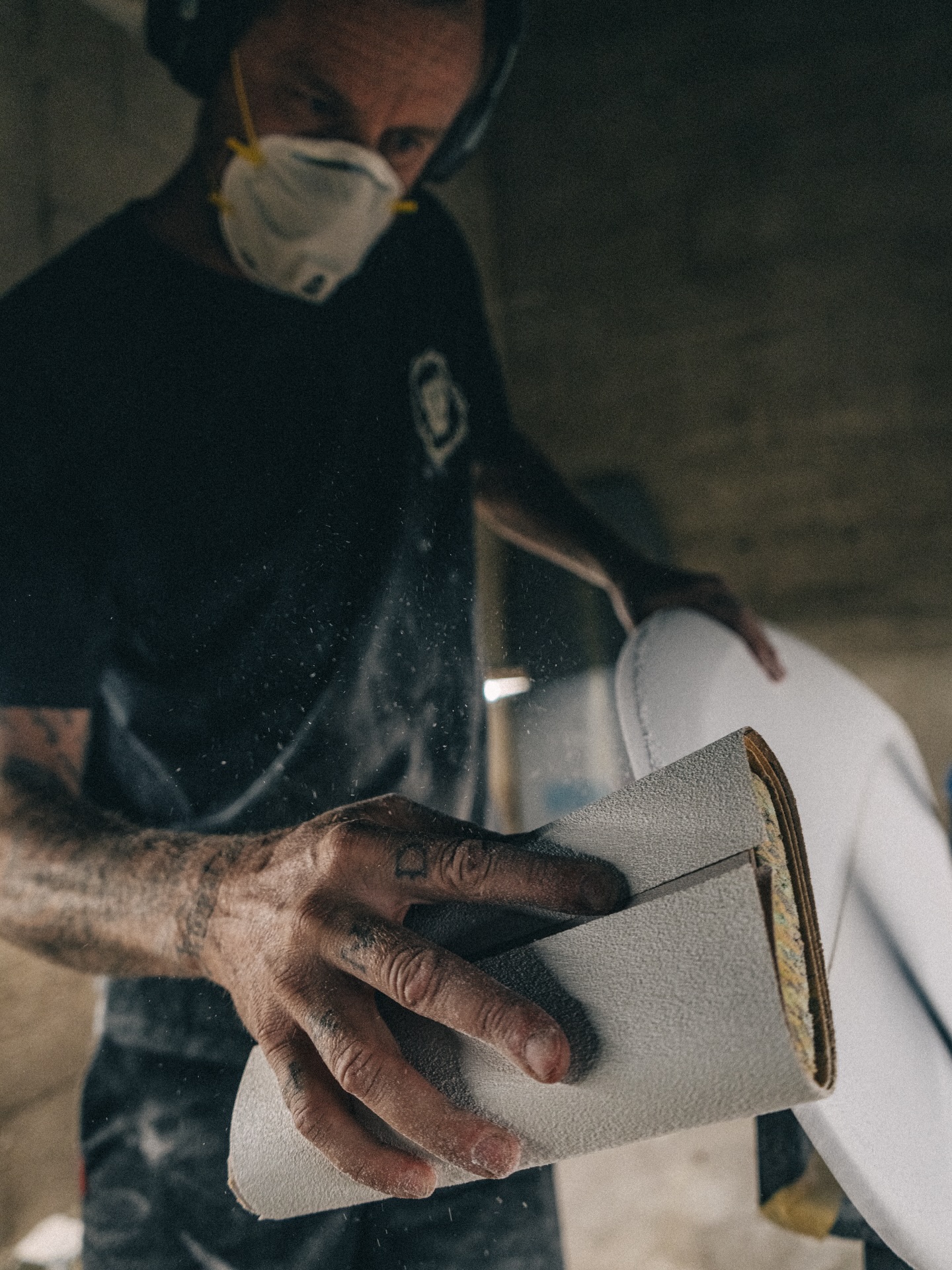 Jeff · Bay · 2026
San Diego shaper. Born in Colorado, started surfing at eighteen, shaped his first board in 2001 — a single-fin egg he describes himself as slightly potato, and still owns. Twenty-plus years later the bay is in San Diego, and the shapes still come from the same place: a personal need at the water.
A shaper has to surf what he shapes.
Otherwise the boards are just guesses.
Right after the first egg came the apprenticeship. Jeff started at Chris Christenson's San Diego shop as the kid who cleaned the factory, prepped orders, kept the place running. In exchange he got the keys at night.
That is where the shaping actually happened — alone in the bay after hours, making the boards he wanted to ride, bringing them back the next morning for Christenson to look at. Repetition, critique, build, surf, correct, build again. The version of the craft that doesn't scale and doesn't apologise.
Most of what carries the McCallum bay today started in those after-hours.
The catalogue is alternative on purpose. Fishes, eggs, twins, quads, midlengths, hybrids — boards that refuse to be the standardised competition shortboard. Most start as a personal need at the water, get refined for a season, then earn or lose their place in the rack.
The PDX is the centre. A fish DNA crossed with a round-pin tail — originally called the Quagg, for Quad + Egg. Speed, paddle and ease, with curve back in the rail. The meat-and-potatoes shape, the most-built McCallum across thousands of hand-shapes.
Around it: the T-EGG (a midlength twin born from a last-minute fin change before glassing), the Kimbo Twin (named after Jeff's English Mastiff, started life as an 8' gun, settled around 7' as the punchy-day favourite), the GYP (a Skip-Frye-template fish with raised rails), the JML log, and the Quad Egg.
People assume the romantic answer is hand-shaping and the dishonest one is CNC. The honest one is: it depends on the board. Some shapes deserve the hand from start to finish. Others are geometric enough that a machine gets ninety-five percent of the way there before the hand earns its place again.
What I refuse to do is hide which one I used. If you bought a hand-shape, the stringer says so. If you bought a CNC-roughed board finished by my hand, the stringer says that too. If you bought a Mexico-made board with my outline, you saw the label before you paid.
That's the whole rule. Everything else is just shaping.